APEC ROES-50 Review 2026
This APEC ROES-50 review covers one of the most widely sold tank-based reverse-osmosis systems in the US: what the maker lists it as reducing, what its certification claim does and does not settle, and where arsenic gets complicated. We do not test filters, so everything here is sourced or labelled as unconfirmed.
Best budget RO - Under-sink RO, 5-stage, NSF 58 listing for TDS.
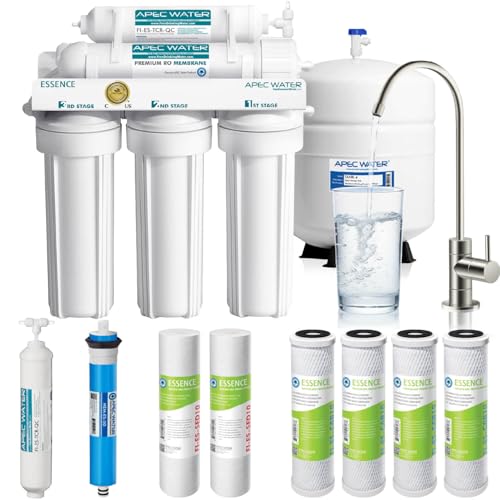
Get it if You want reverse osmosis at the lowest running cost and do not mind a tank under the sink.
Skip it if You need fast refills: 50 gallons a day is slow next to tankless systems, and the tank takes cabinet space.
- USA assembled - domestic parts availability
- Tank-based, works without a pump
- Maker lists PFAS, fluoride, lead and arsenic reduction
- Tank-based only - no tankless option
- 50 GPD - slower than Waterdrop (600-800 GPD)
- 3-4:1 drain ratio - water waste
- No remineralization on the base ROES-50 (PH75 adds it)
NSF 58 certification - what the listing covers
The certification is real: WQA, the Water Quality Association, lists the ROES-50 under NSF/ANSI 58, and the WQA Gold Seal is the mark that goes with it. We read the listing in the WQA product search on 3 October 2026. What it covers is narrow. The ROES-50 carries one reduction claim, TDS, while other APEC models in the same listing (RO-90, RO-Hi, RO-PH90) carry fluoride, lead, arsenic and more. The contaminant list below is APEC's own. This matters more here than on most pages, because a certification to NSF/ANSI 58 is specific: it names the contaminants it covers, and it changes as products are recertified. Look the current listing up in the WQA product search against the exact contaminant you care about, and if it is not there, judge the system on what reverse osmosis does by design.
| Contaminant | On the list APEC publishes | What decides the result |
|---|---|---|
| PFAS (PFOA, PFOS) | Yes | Membrane condition, feed pressure |
| Lead | Yes | Membrane condition, feed pressure |
| Fluoride | Yes | Membrane condition, temperature |
| Arsenic (As V) | Yes | Works on As V; As III needs oxidising first |
| Chlorine | Yes | Carbon pre-filter, replaced on schedule |
| Bacteria | No | Not what RO is for: see UV systems |
The middle column is what the maker publishes, not a measurement of ours. We drop the percentage column that used to sit here: the numbers in it applied to laboratory conditions nobody states on a product page, and repeating them would have dressed a marketing list up as a test result.
Does the APEC ROES-50 remove arsenic?
Mostly, and the nuance decides whether it works for you. Reverse osmosis handles arsenic V (arsenate) well, and that is the form found in most chlorinated municipal water. Arsenic III (arsenite) is the problem: it carries no charge, it is common in untreated well water, and a membrane struggles with it unless it is oxidised to arsenic V first, which chlorination normally does on its own. So on city water this is a reasonable answer to arsenic. On a private well it is not an answer until you have tested the water and know which form you have; if it is arsenic III, you need pre-oxidation ahead of the membrane. We publish no reduction percentage for either form, because we have no source for one that applies to this specific system.
5-stage filtration explained
Who should buy the APEC ROES-50
- Households that want a simple tank RO system that is easy to service
- People who want a tank system that runs without electricity
- Budget-conscious buyers - lowest running cost on this list
- People who want all taps filtered - consider SpringWell CF+ instead
- Well water with bacteria - needs UV addition
- Anyone who needs a certified fluoride, lead or PFAS claim - consider the Waterdrop G3P600 or Aquasana SmartFlow