Best Water Filters for Fluoride Removal 2026
Most water filters do not remove fluoride. Standard carbon filters - including Brita, PUR, and most pitcher filters - have no meaningful fluoride reduction. Only reverse osmosis (NSF 58) and a small number of specific certified filters actually remove fluoride from drinking water. Here's what works and what doesn't.
- Best under-sink RO: APEC ROES-50 - NSF 58 - 90-96% fluoride removal - Mid tier - lowest cost certified option
- Best tankless RO: Waterdrop G3P600 - NSF 58 - 600 GPD - no tank - 2:1 drain ratio - Premium tier
- Best pitcher for fluoride: Clearly Filtered - NSF 42, 53, 244 - one of only pitchers with fluoride reduction
- Best whole house: Aquasana Rhino EQ-1000 - NSF 42, 53 - point-of-entry but limited fluoride reduction vs RO
- Not recommended: Brita, PUR, most carbon filters - do NOT remove fluoride
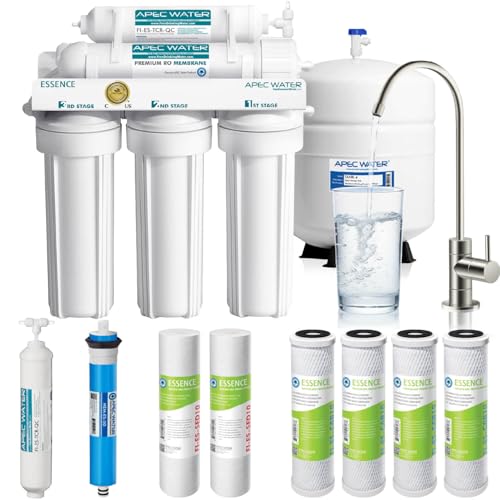
- USA assembled - domestic parts availability
- Tank-based, works without a pump
- Reduces PFAS, fluoride, lead, arsenic
- Tank-based only - no tankless option
- 50 GPD - slower than Waterdrop (600-800 GPD)
- 3-4:1 drain ratio - water waste
- No remineralization on the base ROES-50 (PH75 adds it)
Full review of the APEC ROES-50 →

- Tankless - saves space
- 600 GPD against 50 GPD on the APEC ROES-50
- TDS display confirms filtration
- Higher cost (Premium tier)
- Requires electricity
- No remineralization
Full review of the Waterdrop G3P600 →

- The only pitcher in our catalog that lists fluoride reduction
- Also removes PFAS, lead, arsenic
- Zero installation
- Lower fluoride reduction than RO
- Filter every 100 gallons
- Slower flow than RO tap
Full review of the Clearly Filtered Pitcher →
Full comparison - fluoride removal 2026
| Model | Fluoride | PFAS | Lead | NSF | Type | Annual cost | Buy |
|---|---|---|---|---|---|---|---|
| APEC ROES-50 | 90-96% | Yes | Yes | 58, WQA | Under-sink RO | Mid | Check price on Amazon ↗ (paid link) |
| Waterdrop G3P600 | 90-96% | Yes | Yes | 58, 42, 372 | Tankless RO | Premium | Check price on Amazon ↗ (paid link) |
| Clearly Filtered | Yes | Yes | Yes | 42, 53, 244 | Pitcher | Budget | Check price on Amazon ↗ (paid link) |
| Brita / PUR / standard carbon | No | No | No | 42 only | Pitcher | Budget | Brita review - why we don’t recommend it → |
How to choose a fluoride filter
If you own your home and can install under-sink hardware, a reverse osmosis system is the most effective and cost-efficient fluoride removal solution. APEC ROES-50, a Mid-tier system, is the best value. Waterdrop G3P600 (Premium tier) adds tankless convenience. Both remove 90-96% of fluoride.
If you can't install under-sink hardware, the Clearly Filtered Pitcher is the only pitcher that removes fluoride. No drilling, no installation, portable. The trade-off vs RO: lower fluoride reduction rate and higher cost per gallon. But it's the best no-install fluoride removal option available.
Activated carbon removes contaminants through adsorption - contaminants stick to the carbon surface. Fluoride ions are small and negatively charged, and do not readily adsorb onto standard carbon. This is why Brita and PUR don't remove fluoride, regardless of how many filter stages they claim. Only RO membranes (physical exclusion) or specific activated alumina/bone char media remove fluoride effectively.
NSF 58-certified RO systems typically remove 90-96% of fluoride. US municipal water is fluoridated at 0.7 mg/L (EPA recommendation). After RO, typical output is 0.03-0.07 mg/L - well below any health threshold. If your water is higher than 0.7 mg/L (some well water), test first and verify with a post-filter TDS/fluoride test kit.
FAQ
Does Brita remove fluoride?
Does boiling water remove fluoride?
Is fluoride in tap water dangerous?
What NSF certification covers fluoride removal?
Does a whole house filter remove fluoride?
Buying direct from the brand
Some of the makers on this page also sell the same systems on their own sites and run their own affiliate programs. We earn a commission from those links too, at no extra cost to you. Prices, bundles and warranty terms can differ from Amazon, so compare both before you buy.
- Waterdrop G3P600 on Waterdrop's own site ↗ (paid link)