Aquasana SmartFlow Reverse Osmosis, the OptimH2O's Replacement
The SmartFlow is the under-sink reverse osmosis system Aquasana now sells in place of the OptimH2O. WQA lists it under NSF/ANSI 58, 53, 42 and 401, and between them those listings name fluoride, arsenic V, lead and PFOA/PFOS. Its last stage is a remineralizer, so the water is not left as flat as plain RO water. You pay for that with the usual RO costs: a storage tank under the sink, water to drain, and filters every six months. If you want certified fluoride and PFOA/PFOS reduction at the kitchen tap and care how the water tastes, it is the Mid-tier pick in our catalogue.
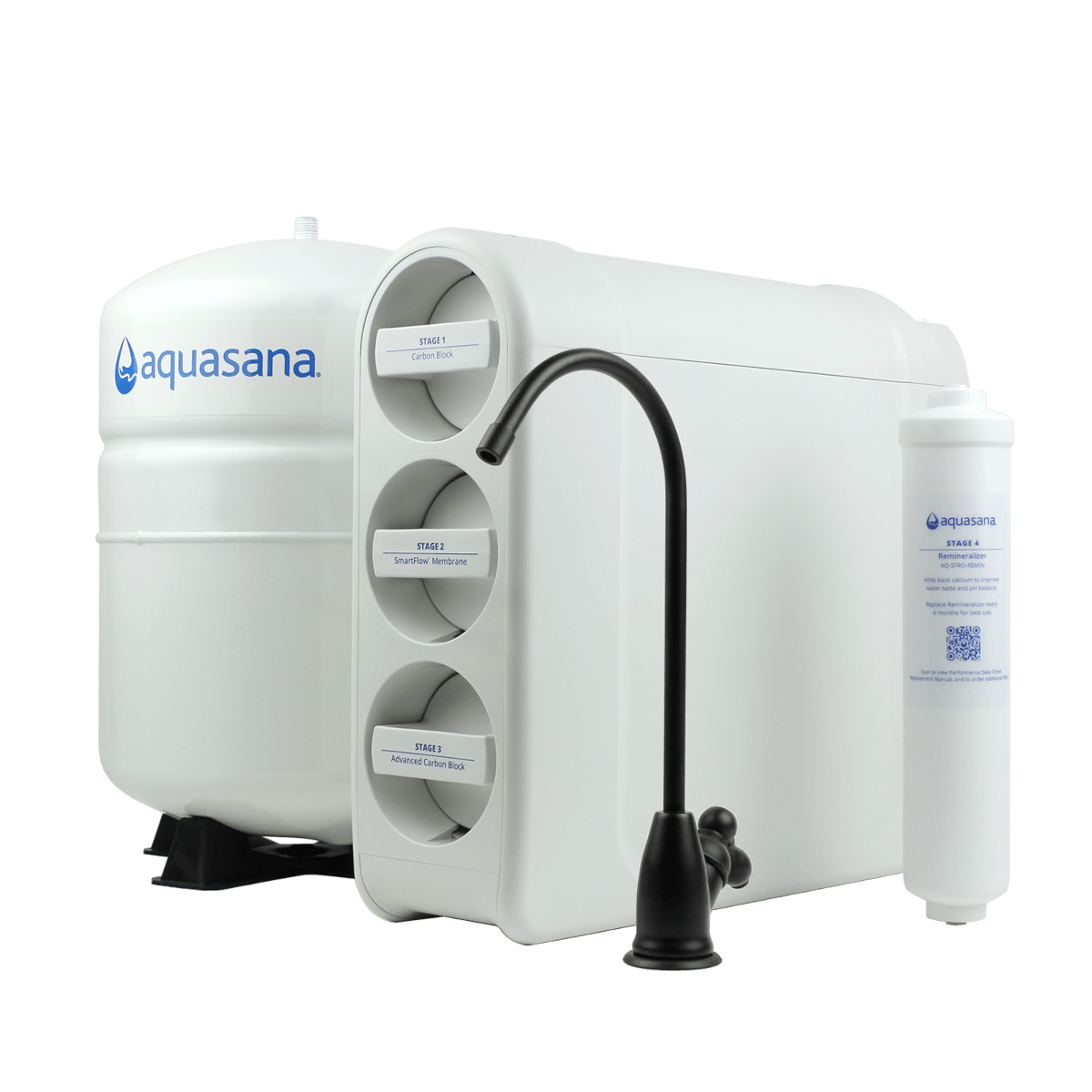
Get it if You want RO at the tap but dislike how flat pure RO water tastes.
Skip it if Cabinet space is tight, or you want the lowest running cost in this catalogue.
- Remineralizing last stage
- Listed for fluoride and arsenic V (NSF 58) and for lead and PFOA/PFOS (NSF 53)
- NSF 401 listing covers pharmaceuticals and microplastics
- Higher running cost than APEC
- Higher upfront price than APEC
- Maker says install means drilling into your pipes
SmartFlow or OptimH2O?
If you came here looking for the OptimH2O: Aquasana no longer sells it as a system. Its product page on aquasana.com now opens the SmartFlow, and the Amazon listing we link to is the SmartFlow too (model AQ-SFRO2). Both systems sit in the same place in Aquasana's lineup, under-sink RO with a remineralizing last stage, and their WQA listings name the same main substances. One difference shows in the listings: the SmartFlow's arsenic V claim was tested at 50 ppb in the incoming water, the OptimH2O's at 300 ppb. If you already own an OptimH2O, Aquasana still sells its replacement filters.
How it filters
Aquasana describes four stages. A carbon block goes first and takes out chlorine, taste and odor so they do not reach the membrane. Next comes the reverse osmosis membrane, which Aquasana credits with fluoride, nitrate, nitrite, arsenic and PFOA/PFOS. A second carbon block with ion exchange follows; Aquasana lists lead, microplastics, VOCs and mercury for it. The last stage is the remineralizer, which puts minerals back into the water after the membrane has stripped them out.
Filtered water collects in a 3.2-gallon tank. Aquasana says you can draw 1.4 to 3.2 gallons from it depending on your water pressure. It rates daily production at 25.7 gallons (the membrane alone at 51.4), and the faucet runs at 0.7 gallons a minute with a full tank. It needs 40 to 80 psi of incoming pressure.
Certification: what the listings say
The SmartFlow is certified through WQA, not NSF itself, so its listings are in the WQA product search, not the NSF database. Under NSF/ANSI 58, the reverse osmosis standard, WQA names TDS, fluoride, arsenic V, barium, cadmium, copper, hexavalent and trivalent chromium, nitrate, nitrite, radium 226/228, selenium and turbidity. Under NSF/ANSI 53 it names lead, mercury, PFOA, PFOS, cysts, asbestos, MTBE and VOCs. NSF/ANSI 42 covers chlorine, chloramine and taste and odor, and NSF/ANSI 401 lists 16 emerging compounds, among them several pharmaceuticals and microplastics. We read these listings for model AQ-SFRO and AQ-SFRO2 on 3 October 2026.
Aquasana's page also mentions CSA B483.1, a Canadian drinking water standard, and writes "NSF/ANSI 53 (includes P473)". P473 was a separate PFOA/PFOS protocol that has since been folded into 53 and 58, so the 53 listing above already covers it.
Filters, installation and warranty
Both carbon stages are rated for 6 months or 250 gallons, the remineralizer for 6 months and the membrane for 12, according to Aquasana. Installation means drilling into your water pipes for the feed and drain connections, which is why Aquasana recommends a professional if you are not used to plumbing work. The all-metal faucet comes in four finishes, or you can buy the system without it and use an RO faucet you already have; Aquasana notes it must have an air gap certified to NSF/ANSI 58 to keep the system's certification. Aquasana gives a 2-year limited warranty and a 90-day satisfaction guarantee.
Who it's for
The SmartFlow suits a household that wants certified fluoride, lead and PFOA/PFOS reduction at the kitchen tap and minds the flat taste of plain RO water. It does not suit renters who cannot drill into plumbing, or anyone after treatment for the whole house; for point-of-entry filtering, see our Aquasana Rhino EQ-1000 review. To compare it with the rest of the lineup, see our Aquasana brand review.
SmartFlow vs Waterdrop G3P600 vs APEC ROES-50
| Feature | Aquasana SmartFlow | Waterdrop G3P600 | APEC ROES-50 |
|---|---|---|---|
| Price tier | Mid | Premium | Budget |
| NSF/ANSI listings | 58, 53, 42, 401 | 58, 53, 42, 372 | 58 (TDS only) |
| Remineralization | Last stage | No | No |
| Tank | 3.2 gal tank | Tankless | 3.2 gal tank |
| PFOA/PFOS | Listed (NSF 53) | Listed (NSF 53) | Not certified |
| Best for | Taste plus listed fluoride, lead and PFOA/PFOS reduction | Space-saving, high flow rate | Lowest cost, TDS-only listing |
Choose the Waterdrop G3P600 if: under-sink space is tight and you want a tankless design with a faster flow; see our Waterdrop G3P600 review.
Choose the APEC ROES-50 if: price comes first and you do not need remineralization; see our APEC ROES-50 review.
Choose the SmartFlow if: you want listed fluoride, lead and PFOA/PFOS reduction and remineralized water, and have room for a tank.