Aquasana Rhino EQ-1000 Review 2026
The Aquasana Rhino EQ-1000 is a whole-house carbon/KDF filter built for households that want point-of-entry protection without salt, electricity, or wastewater. Aquasana lists NSF/ANSI 42 and 53 for it, but we could not find those listings; its certifications on file cover materials safety, not contaminant reduction. It is rated for 1,000,000 gallons (roughly 10 years for an average household), and delivers a 7 GPM flow rate that holds up in multi-bathroom homes. Aquasana says it reduces chlorine, lead, mercury and a range of organic compounds at the point water enters the house. Two honest limitations: it is not a PFAS-removal system in the way a reverse osmosis unit is, and it does not soften water or reduce hardness/scale. For households that want whole-house chlorine reduction with minimal ongoing maintenance and are comfortable relying on the maker's figures, it remains a strong option in its class.
Not confirmed does not mean false: it means we could not find that certification in the NSF, IAPMO or WQA listings, so judge this one on the specs above, which we could check.
Get it if Chlorine taste and smell reach every tap and you want one unit for the whole house.
Skip it if Your problem is PFAS, arsenic or nitrates: a whole-house carbon filter is the wrong tool, use RO at the tap.
- 1,000,000 gallons - roughly 10 years of filtration
- 7 GPM flow rate - no pressure drop for the whole home
- Maker rates it for chlorine, lead, mercury and organic compounds
- Salt-free - no wastewater, no electricity, no brine tank
- Does not remove PFAS to reverse-osmosis levels
- Does not soften water or reduce hardness/scale
- High upfront cost (Premium tier)
- Professional installation recommended
What is the Aquasana Rhino EQ-1000
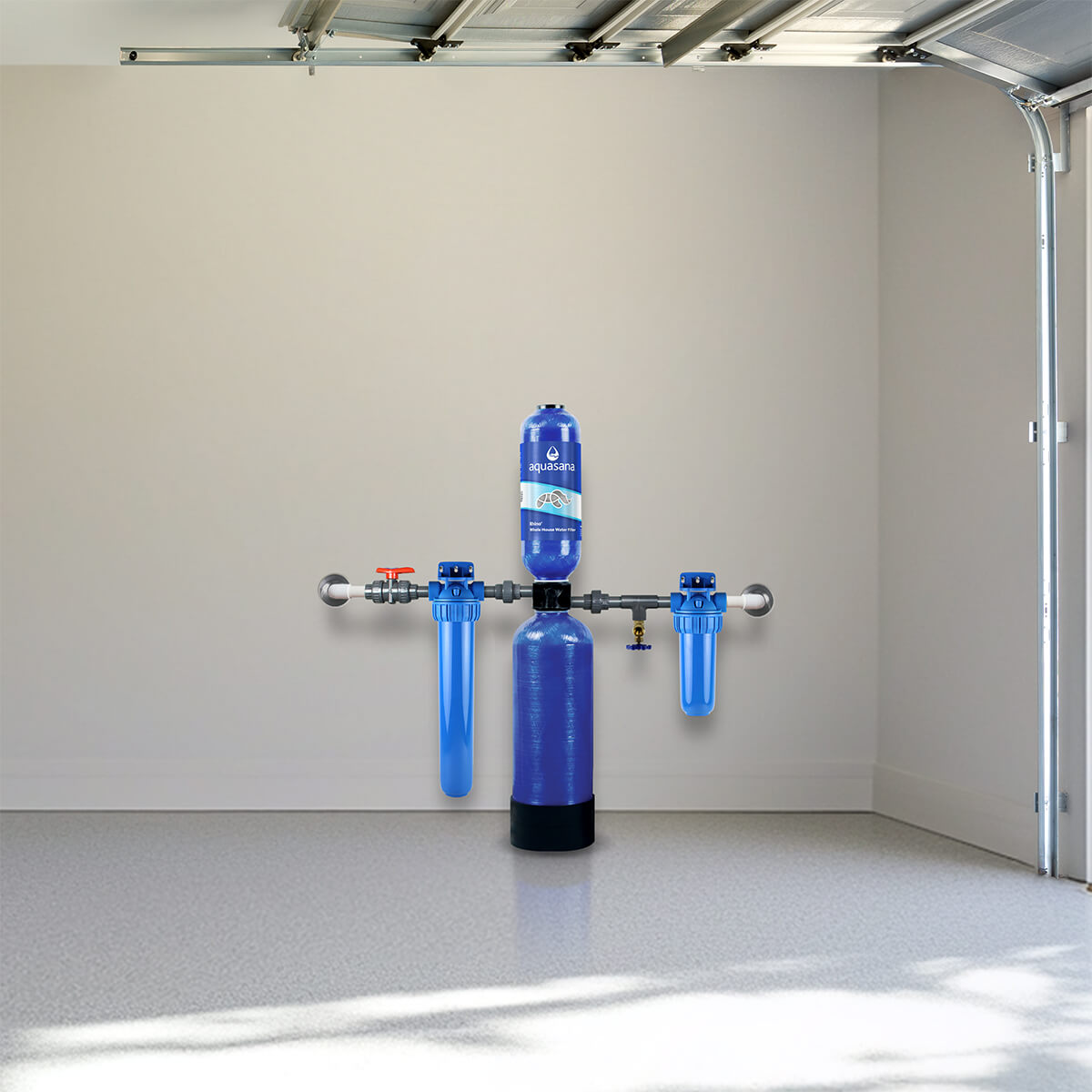
The Rhino EQ-1000 is a whole-house, point-of-entry water filter that treats every tap in the home rather than just the kitchen sink. It uses a combination of catalytic carbon and KDF (kinetic degradation fluxion) process media housed in a large upflow tank, paired with a pre-filter that captures sediment before water reaches the main media bed. Because it treats water at the point it enters the house, it protects plumbing, fixtures, showers, and every faucet - not just drinking water.
Aquasana rates the system for 1,000,000 gallons of throughput, which works out to approximately 10 years for a typical family of four, though actual filter life depends on household water usage and the quality of the incoming municipal or well supply. This is substantially longer than most under-sink systems, which typically need cartridge changes every 6-12 months.
Certification - what we could and could not find
Aquasana lists two reduction standards for the Rhino: NSF/ANSI 42, which covers chlorine taste and odor, and NSF/ANSI 53, which covers health-effect contaminants such as lead and cysts. We looked for both in the NSF, IAPMO R&T and WQA directories on 3 October 2026 and found neither. WQA does list the Rhino (WH-1000) under NSF/ANSI/CAN 61 and 372, which certify that its materials are safe for drinking water and lead-free, and under the Canadian CSA B483.1. Those are real certifications, but they say nothing about what the filter removes. Aquasana's performance data sheet is the maker's own document, not a third-party listing.
If PFAS ("forever chemicals") removal is a priority, look for systems specifically certified under NSF/ANSI 53 or 58 for PFOA/PFOS, or pair a whole-house system like this one with a certified point-of-use reverse osmosis unit.
What it removes - and what it doesn't
Based on its catalytic carbon/KDF media and Aquasana's own figures, the Rhino EQ-1000 is designed for free chlorine and chloramine taste/odor, lead, and a range of volatile organic compounds and pesticide/herbicide residues commonly found in municipal water. KDF media also helps control bacterial growth within the filter bed itself.
Being transparent about limitations: this is not a reverse osmosis system, so it will not reduce PFAS, nitrates, arsenic, fluoride, or dissolved salts to the degree an RO membrane does. It is also not a water softener - it will not reduce calcium/magnesium hardness or prevent scale buildup in pipes and appliances. Homes with hard water typically pair a whole-house carbon filter like this with a separate salt-based or salt-free conditioner.
Flow rate and filter life
The Rhino EQ-1000 is rated for a 7 GPM (gallons per minute) flow rate, which is sized to avoid the pressure drop that smaller point-of-entry filters can cause when multiple fixtures run at once - for example, a shower running while a dishwasher is filling. The 1,000,000-gallon media rating means most households replace the main tank media roughly once per decade, though the sediment pre-filter should be checked and replaced more frequently (every 3-6 months) depending on incoming water quality.
Installation and maintenance
Whole-house systems like the Rhino EQ-1000 are installed at the main water line, typically in a basement, garage, or utility closet, and generally require professional plumbing installation - this is a larger, more involved job than an under-sink filter. Aquasana backs the tank with a long-term warranty (confirm current terms on the manufacturer's page before purchase). Ongoing maintenance is limited to periodic pre-filter changes and a media replacement around the 10-year mark, making it lower-maintenance over its lifespan than most under-sink or countertop systems.
Who it's for
The Rhino EQ-1000 makes the most sense for homeowners (renters typically can't install whole-house systems) who want chlorine and lead reduction at every tap in the house, are comfortable with a higher upfront investment in exchange for a decade of low-maintenance operation, and either don't need PFAS-level filtration or plan to pair it with a point-of-use RO system for drinking water specifically. It's less suited to renters, apartment dwellers, or anyone whose primary concern is PFAS or fluoride reduction - for those needs, a certified under-sink RO system is the better fit.
Rhino EQ-1000 vs SpringWell CF+ vs iSpring WGB32BM
| Feature | Aquasana Rhino EQ-1000 | SpringWell CF+ | iSpring WGB32BM |
|---|---|---|---|
| Price tier | Premium | Premium | Mid |
| Filter type | Catalytic carbon + KDF | Carbon + KDF | 3-stage sediment + carbon block + carbon |
| Rated capacity | 1,000,000 gal / ~10 yrs | ~1,000,000 gal (model dependent) | 100,000 gal (~3 stages replaced separately) |
| Water softening | Add-on available | Softener add-on available | No |
| Salt-free | Yes | Yes | Yes |
| Best for | Low-maintenance whole-house chlorine reduction | Customizable flow-rate sizing by household size | Budget-conscious whole-house entry point |
Choose SpringWell CF+ if: you want a system sized precisely to your household's fixture count and want the option to add a salt-based or salt-free softener from the same product line. See our full SpringWell CF+ review for details.
Choose iSpring WGB32BM if: budget is the priority and you're comfortable managing three separate big-blue filter stages rather than a single long-life tank. See our full iSpring WGB32BM review for details.
Choose the Rhino EQ-1000 if: you want a decade-long single-tank media life, and a 7 GPM flow rate with minimal ongoing maintenance.