Best PFAS Water Filters 2026
We reviewed dozens of filters against NSF certification data. These are the ones that actually remove PFAS from your water - verified, not just marketed.
Only NSF 53 and NSF 58 certified filters reliably remove PFAS. Standard pitcher filters (Brita, PUR) do not remove PFAS - regardless of marketing claims.

Not confirmed does not mean false: it means we could not find that certification published by the maker or in the NSF listing, so judge this one on the specs above, which we could check.
Get it if You rent, move often, or want fluoride reduction without installing anything.
Skip it if You fill more than a pitcher a day: the flow is slow and filters run 100 gallons.
- The only pitcher in our catalog that lists fluoride reduction
- Also removes PFAS, lead, arsenic
- Zero installation
- Lower fluoride reduction than RO
- Filter every 100 gallons
- Slower flow than RO tap
Full review of the Clearly Filtered Pitcher →
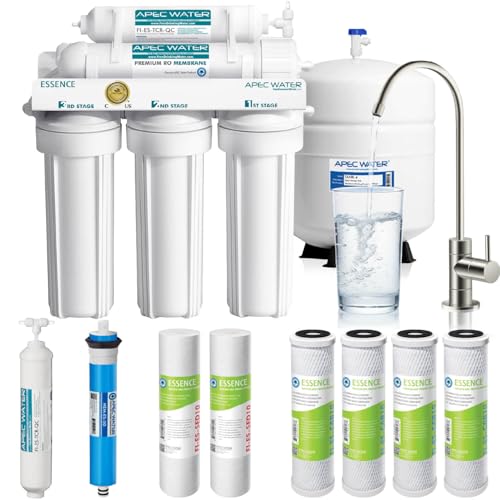
Not confirmed does not mean false: it means we could not find that certification published by the maker or in the NSF listing, so judge this one on the specs above, which we could check.
Get it if You want reverse osmosis at the lowest running cost and do not mind a tank under the sink.
Skip it if You need fast refills: 50 gallons a day is slow next to tankless systems, and the tank takes cabinet space.
- USA assembled - domestic parts availability
- Tank-based, works without a pump
- Reduces PFAS, fluoride, lead, arsenic
- Tank-based only - no tankless option
- 50 GPD - slower than Waterdrop (600-800 GPD)
- 3-4:1 drain ratio - water waste
- No remineralization on the base ROES-50 (PH75 adds it)
Full review of the APEC ROES-50 →
Not confirmed does not mean false: it means we could not find that certification published by the maker or in the NSF listing, so judge this one on the specs above, which we could check.
Get it if Chloramine, not just chlorine, is what your utility uses, and you want whole-house treatment.
Skip it if You want to buy today: we have no purchase link for it yet.
- Removes chloramine, not just chlorine
- Whole house - every tap protected
- Lifetime tank warranty
- DIY installation friendly
- Does not remove bacteria
- Limited iron removal
- 9 GPM - not for large homes
Full review of the SpringWell CF+ →
Brita filters are certified to NSF 42 only - which covers taste and odor, not PFAS or lead. Despite marketing claims, standard Brita pitcher filters are not certified to remove PFAS. Verified against the NSF International database.
Read full analysis: Does Brita remove PFAS? →