Salt-free or salt-based: what each one really does
Two products are sold under one word, and they do different things. A salt-based softener removes hardness minerals from the water. A salt-free conditioner leaves them in and changes how they behave. Both are useful; only one of them is a softener, and the confusion costs people a purchase.
If scale on the kettle, the heater and the shower head is what bothers you, and you have no drain to plumb to, a salt-free conditioner is a reasonable answer. If laundry comes out grey, soap will not lather and skin feels filmy, that is hardness itself and only ion exchange removes it. Nobody can tell you which you have from a website: a hardness test strip costs almost nothing and settles it in a minute.
What each one does to the water
| Salt-free conditioner | Salt-based softener | |
|---|---|---|
| Removes calcium and magnesium | No | Yes |
| Hardness reading after treatment | Unchanged | Lower |
| Targets scale on surfaces | Yes | Yes |
| Helps lather and laundry | No | Yes |
| Needs a drain connection | No | Yes |
| Needs salt refills | No | Yes |
| Adds sodium to the water | No | Yes |
Salt-free: Kind E-3000
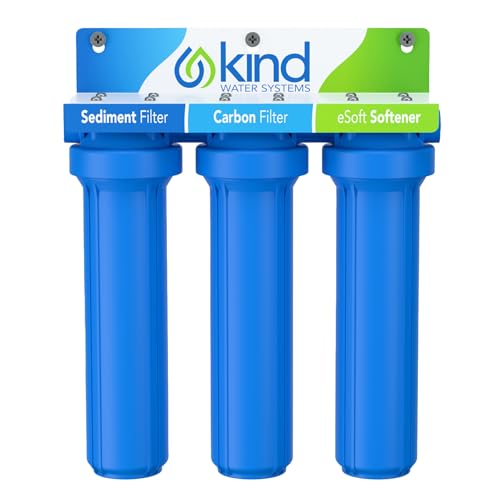
Get it if Scale on fixtures is the complaint and you cannot plumb a drain for a softener.
Skip it if You want soft water for washing and laundry: that needs ion exchange.
- No salt, no brine tank, no drain connection
- Cartridge format fits where a tank does not
- Does not remove hardness: minerals stay in the water
- Cartridges are the running cost
Three cartridges in a row: sediment, carbon, then conditioning media. No tank, no brine, no drain, and it fits in the sort of space that will never take a softener. The carbon stage means it is doing filtration work as well, which is part of why this format suits a flat or a house on city water where taste matters as much as scale.
Salt-based: Aquasana SimplySoft

Get it if Hard water measured in grains and a utility space that can take a tank and a drain.
Skip it if You have no drain, no space, or you are on a sodium-restricted diet without a bypass tap.
- Ion exchange: actually removes hardness
- Digital metered valve rather than a timer
- Needs a drain connection and salt refills
- Tank plus brine cabinet needs floor space
Ion exchange with a metered digital valve, rated by the maker at 40,000 grains. A metered valve regenerates based on how much water you have actually used rather than on a clock, which is the difference between a system that wastes salt and one that does not. It needs a drain, floor space for tank and brine cabinet, and salt on a schedule.
On a private well, iron and pH matter as much as hardness. Water softeners for well water compares two models with NSF/ANSI 44 listings; we found no such listing for the SimplySoft.
How to tell which problem you have
Hardness is measured in grains per gallon and a test strip reads it in seconds. Anything under about 3 gpg is soft and neither product is worth buying; 7 to 10 is where people start noticing; above 10 the effects are obvious in laundry and on every fixture. Your water utility publishes an annual report with a figure for the supply, which is a good starting point but not a substitute for testing what comes out of your own tap.
One more distinction worth making before spending: scale and chlorine are different complaints. If the shower smells of chlorine rather than furring up, that is a shower filter question, and it costs a fraction as much.
What neither one does
Neither is a drinking water filter. A softener trades hardness for sodium and does nothing about lead, PFAS or fluoride; a conditioner leaves the minerals in place. If the reason you are shopping is what is dissolved in the water rather than what it does to the plumbing, the answer is reverse osmosis or an under-sink filter, fitted at the tap you drink from.