Water filters for microplastics: which reverse osmosis and carbon filters are certified
NSF describes microplastics as extremely small synthetic particles that do not dissolve in water, and says filters certified to NSF/ANSI 401 help reduce them. So a filter is certified for microplastics when its 401 listing names them, whatever kind of filter it is. We read the listings for the filters on our site.
Three reverse osmosis systems we cover have an NSF/ANSI 401 listing that names microplastics: the AquaTru Classic and AquaTru Carafe on the counter, and the Aquasana SmartFlow under the sink. You do not need reverse osmosis for the claim. Three carbon filters have it too. The other reverse osmosis systems on our site had no 401 listing in the records we read.
What the certification covers
NSF/ANSI 401 is the standard for what NSF calls emerging compounds: drugs, herbicides, pesticides and other substances found in drinking water at trace levels. A 401 listing names the substances a model was tested for, so two filters certified to the same standard can carry different lists. In the listings we read, microplastics appears as its own line next to the compounds.
NSF also reminds buyers that certification does not mean a filter reduces all possible contaminants, so check that the listing names the one you care about. For what each standard covers in general, see NSF certifications explained.
Reverse osmosis systems with a listing that names microplastics
| Model | Type | NSF/ANSI 401 listing | Also certified for | Listing read |
|---|---|---|---|---|
| AquaTru Classic | Countertop, no plumbing | IAPMO W-10195, AT2000 series | Fluoride, lead, arsenic and TDS (58); PFOA, PFOS and VOCs (53) | 5 Oct 2026 |
| AquaTru Carafe | Countertop, glass carafe | IAPMO W-10195, AT100 series | Fluoride, lead, arsenic and TDS (58); PFOA/PFOS and VOCs (53) | 5 Oct 2026 |
| Aquasana SmartFlow | Under the sink, with tank | WQA, AQ-SFRO2 | Fluoride and arsenic V (58); lead and PFOA/PFOS (53) | 3 Oct 2026 |
All three 401 listings name the same set: microplastics plus fifteen compounds, from bisphenol A and DEET to ibuprofen and estrone. The AquaTru units need no plumbing: you fill a tank and plug them in. The SmartFlow goes under the sink and needs a drain line, like other under-sink reverse osmosis systems.

Get it if You want the widest list of certified reductions in a countertop unit and cannot plumb anything in.
Skip it if Counter space is tight: the Carafe has the same reduction list in a smaller body.
- NSF/ANSI 58 listing covers fluoride, lead, arsenic (V), nitrate/nitrite, perchlorate, radium, barium, chromium, copper, selenium, cyst and TDS
- NSF/ANSI 53 listing for PFOA, PFOS and VOCs
- NSF/ANSI 401 listing for pharmaceuticals and microplastics
- No plumbing: fill the tank and press a button
- Needs an outlet, and you refill the tank by hand
- The AquaTru name covers several units: the listings above are for the Classic (AT2000 series)

Get it if One or two people who want certified fluoride and PFAS reduction in a smaller unit.
Skip it if A larger household drinks and cooks with filtered water all day: the Classic keeps up better.
- NSF/ANSI 58 listing covers fluoride, lead, arsenic, nitrate/nitrite, hexavalent chromium, perchlorate and TDS
- NSF/ANSI 53 listing for PFOA/PFOS and VOCs
- Filtered water collects in a glass carafe that goes in the fridge
- Slower than the Classic: 35 against 54 gallons a day in the listings
- Needs an outlet, and you refill the tank by hand
Before you buy: check that the Amazon listing title includes AquaTru Glass Carafe.
Check price on Amazon ↗ (paid link)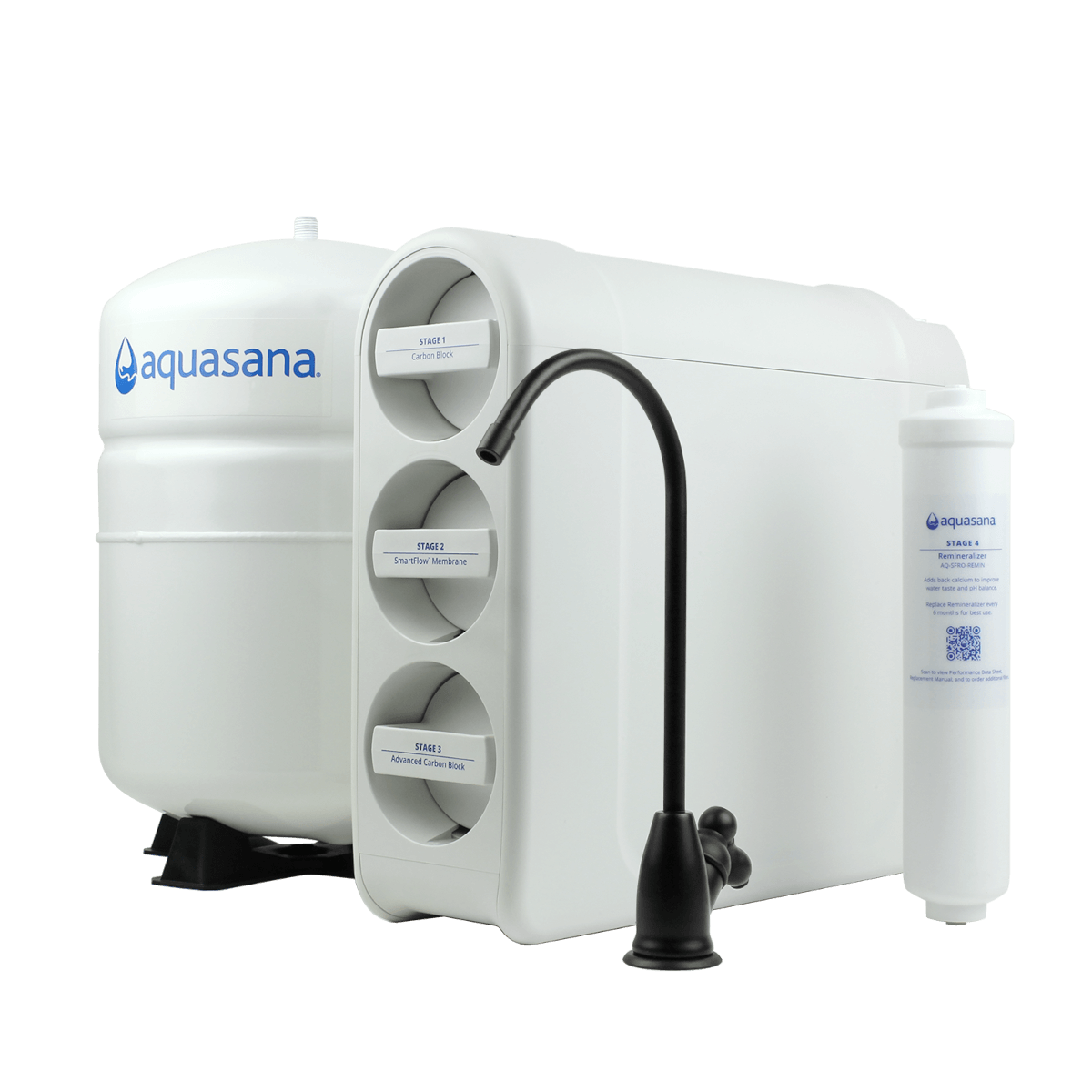
Get it if You want RO at the tap but dislike how flat pure RO water tastes.
Skip it if Cabinet space is tight, or you want the lowest running cost in this catalogue.
- Remineralizing last stage
- Listed for fluoride and arsenic V (NSF 58) and for lead and PFOA/PFOS (NSF 53)
- NSF 401 listing covers pharmaceuticals and microplastics
- Higher running cost than APEC
- Higher upfront price than APEC
- Maker says install means drilling into your pipes
Before you buy: check that the Amazon listing title includes SmartFlow. The maker gives a filter life of 6 months (carbon), 12 months (membrane).
Check price on Amazon ↗ (paid link) Buy direct from Aquasana ↗ (paid link)Reverse osmosis systems on our site without one
The Waterdrop G3P600, G3P800, X8, M6SL and M6H, the APEC ROES-50, the iSpring RO500 and the Bluevua RO100ROPOT-Lite had no NSF/ANSI 401 listing in the registry records we read for them in October 2026. A missing listing tells you nothing about how the membrane performs on microplastics: no certifier has tested that claim for these models, so we do not make it for them. Their other listings are on our reverse osmosis systems page.
You do not need reverse osmosis for the claim
Three carbon filters on our site carry a 401 listing that names microplastics. The Aquasana Claryum 3-Stage Max Flow (WQA, AQ-6300M) fits under the sink and sends no water to a drain. On the counter, the Aquasana Clean Water Machine (WQA, AQ-CWM2-X-Y) and the Ninja HydraSense (IAPMO W-30346) need no installation at all. Compare them on our countertop water filters page.
Choose a membrane system when your list goes beyond what a carbon listing covers. On our site, fluoride appears only in NSF/ANSI 58 listings.
FAQ
Does reverse osmosis remove microplastics?
Do I need reverse osmosis to filter microplastics?
Is NSF/ANSI 58 enough for microplastics?
How do I check a filter myself?
What about plastic in the kettle I boil filtered water in?
Sources
- NSF, Water Filters FAQs: what microplastics are and which standard covers them.
- NSF, NSF Standards for Water Treatment Systems: what certification does not promise.
- NSF, NSF/ANSI 42, 53 and 401.
- Certification listings: AquaTru in the IAPMO R&T directory (file W-10195); Aquasana in the WQA product search; Ninja HydraSense at IAPMO R&T (file W-30346). Links to each record are on the product cards.
- Web pages read 29 October 2026. Listings read on the dates in the table.