Water softener vs water filter: what each one does, and when you need both
A water softener and a water filter solve different problems. The softener takes out calcium and magnesium, the minerals behind scale and soap scum. A filter reduces things you may not want to drink, such as chlorine taste, lead or PFAS, depending on which one you buy. Hard water that also has a drinking-water problem needs both, and they usually sit in different places in the house.
Scale on fixtures and pans, soap film and detergent residue point to hardness, and only a softener removes it. Something in your water report you would rather not drink points to a filter whose listing names that substance. If you have both problems, the usual setup is a softener where the water enters the house and a drinking-water filter at the kitchen tap. Neither does the other's job.
What each one is certified to do
NSF writes the standards both kinds of equipment are certified against, and the standard number tells you which job a product was tested for. The descriptions below are NSF's own, shortened.
| Standard | Type of product | What it covers |
|---|---|---|
| NSF/ANSI 44 | Water softener | Cation exchange resin, regenerated with sodium or potassium chloride, reduces hardness from calcium and magnesium |
| NSF/ANSI 42 | Filter | Aesthetic impurities such as chlorine, taste and odor |
| NSF/ANSI 53 | Filter | Contaminants with a health effect, as regulated by the EPA and Health Canada |
| NSF/ANSI 401 | Filter | Up to 15 emerging contaminants, such as pharmaceuticals and chemicals not yet regulated |
| NSF/ANSI 58 | Reverse osmosis | A membrane system that reduces contaminants regulated by the EPA and Health Canada |
Side by side
| Water softener | Drinking-water filter | |
|---|---|---|
| Removes calcium and magnesium | Ion exchange | Not what 42, 53 or 401 certify |
| Reduces lead, nitrate, pesticides | Not removed by ion exchange | If the listing names them |
| Reduces chlorine taste and odor | Not a softener claim | NSF/ANSI 42 |
| Adds sodium | 7.5 mg per quart per grain removed | No |
| Needs salt and a drain | Brine regeneration | Cartridges only (RO needs a drain) |
| Usual location | Where water enters the house | Kitchen tap, or the whole house |
What a softener does, and what it leaves alone
Inside a softener is a bed of sand-like resin coated with sodium. As hard water passes through, the resin trades its sodium for calcium and magnesium. When the resin is full of hardness minerals, the softener regenerates: it flushes the bed with brine from the salt tank and sends the minerals down the drain. Penn State Extension estimates about 50 gallons of water per regeneration, which matters if you are on a septic system.
Penn State is blunt about the limits: softening removes hardness minerals and fixes nuisances, not health threats, and a softener will not necessarily remove the more serious drinking water contaminants. The University of Nebraska-Lincoln names some of them: bacteria, hydrogen sulfide, silt and sand, lead, nitrate and pesticides. Hardness itself is not a health issue. Penn State calls calcium and magnesium essential nutrients.
How hard is hard? Penn State's classes, in grains per gallon of calcium carbonate:
| Class | Grains per gallon | mg/L (ppm) |
|---|---|---|
| Soft | Under 1.0 | Under 17 |
| Slightly hard | 1.0 to 3.5 | 17 to 60 |
| Moderately hard | 3.5 to 7.0 | 60 to 120 |
| Hard | 7.0 to 10.5 | 120 to 180 |
| Very hard | Over 10.5 | Over 180 |
Below 7 grains per gallon, Penn State expects no major scaling or soap film, so many households at that level can skip a softener. Your utility's annual report gives a hardness figure for the supply; on a private well you need a test.
A softener with a listing
Plenty of softeners have no NSF/ANSI 44 listing at all: when we checked on 5 October 2026, we found none for the Aquasure Harmony series, the Aquasana SimplySoft, or the SpringWell and iSpring softeners. Two that are listed are compared on our well water softener page: the WaterBoss 700 below and the Kenmore 420, with about twice the capacity according to the two makers.

Get it if A household of up to about four on a well with moderate hardness and some dissolved iron.
Skip it if Your water is very hard and the family is large: the capacity runs out fast and it regenerates often.
- NSF/ANSI 44 listing: hardness capacity verified, efficiency rated, plus barium and radium 226/228
- Built-in sediment filter, per the maker
- Made for city or well water, per the maker
- Iron reduction (maker states up to 10 ppm of clear-water iron) is not part of the NSF listing
- 20,500 grains is small for very hard water or a large household
- Needs a drain and salt refills like any ion-exchange softener
Before you buy: check that the Amazon listing title includes 74011.
Check price on Amazon ↗ (paid link)What a filter does, and what it leaves alone
A carbon filter holds contaminants on the surface and in the pores of its media, which is the mechanism NSF/ANSI 42 and 53 cover. Which substances it reduces depends entirely on the listing: one model's NSF/ANSI 53 listing may name lead and PFOA/PFOS, another's only mercury. A reverse osmosis system adds a membrane and is certified under NSF/ANSI 58; on some models that listing includes fluoride. Hardness reduction is the NSF/ANSI 44 claim, which belongs to softeners.
Where the filter goes depends on what you want filtered. A drinking-water filter at the kitchen tap treats what you drink and cook with. A whole house filter treats every tap, though none of the whole house systems on that page has a reduction listing we could find.
A drinking-water filter with a listing
The Aquasana Claryum 3-Stage Max Flow is WQA certified under NSF/ANSI 42, 53 and 401, and its 53 listing names lead and PFOA/PFOS. It has no membrane, so it sends no water to the drain. If you want fluoride reduced as well, the Aquasana SmartFlow reverse osmosis system is listed under NSF/ANSI 58 for fluoride; see our SmartFlow review. More options are on our under-sink water filters page.
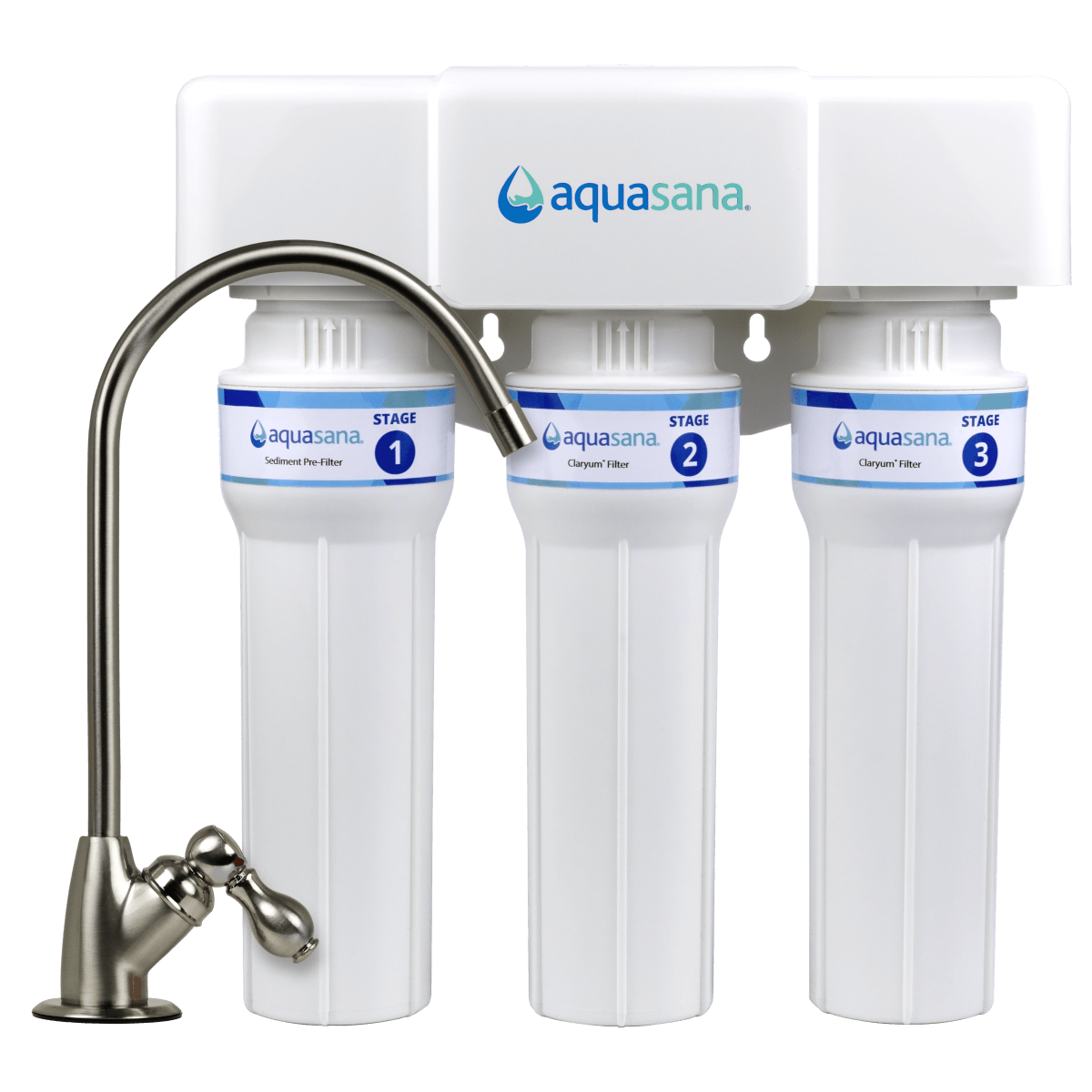
Get it if You want filtered water at the kitchen tap with no tank and no drain line.
Skip it if Fluoride or arsenic is your reason for filtering: this design does not address either.
- Certified for PFOA/PFOS, lead and pharmaceuticals
- No storage tank - instant flow
- Zero water waste - no RO membrane
- Carbon system: not a fluoride filter
- Does NOT remove arsenic or nitrates
- Requires drilling for dedicated faucet
- Filter replacement every 6 months
Before you buy: check that the Amazon listing title includes Claryum 3-Stage Max Flow. The maker gives a filter life of 6 months.
Check price on Amazon ↗ (paid link) Buy direct from Aquasana ↗ (paid link)When you need both
You need both when the water is hard enough to bother you and your water report or well test shows something you want out of your drinking water. The two then do separate jobs in separate places:
- Sediment or iron filtration, if your water needs it, goes first. Penn State says red, oxidized iron clogs softener resin and should be filtered out before the softener.
- The softener treats the water where it enters the house. Penn State notes that not all the water needs softening: toilets, outside taps and basement sinks can be bypassed.
- A drinking-water filter goes at the kitchen tap. Many homes also run the kitchen cold line around the softener, which the University of Nebraska-Lincoln describes, so drinking water skips the added sodium.
If you are weighing a salt-free conditioner instead of a softener, read salt-free vs salt-based softeners first: a conditioner leaves the hardness minerals in the water, so the comparison above does not apply to it.
FAQ
Does a water softener filter water?
Will a water filter soften hard water?
Should the filter go before or after the softener?
Is softened water OK to drink?
Is a combined softener and filter system one machine?
Sources
- NSF, NSF Standards for Water Treatment Systems.
- Penn State Extension, Water Softening (updated September 8, 2025).
- University of Nebraska-Lincoln Extension, Drinking Water Treatment: Water Softening (Ion Exchange), NebGuide G1491 (revised September 2014).
- Certification listings: NSF/ANSI 44 for the WaterBoss 700 and Kenmore 420 at info.nsf.org; Aquasana Claryum and SmartFlow in the WQA product search. Links to each record are on the product cards.
- Web pages read 26 October 2026.