
CleanWaterAdviser is reader-supported. We may earn a commission via affiliate links at no extra cost to you. Full disclosure →
The Aquasana Rhino EQ-1000 is a whole-house carbon/KDF filter built for households that want point-of-entry protection without salt, electricity, or wastewater. It’s NSF/ANSI 42 and 53 certified, rated for 1,000,000 gallons (roughly 10 years for an average household), and delivers a 7 GPM flow rate that holds up in multi-bathroom homes. It reduces chlorine, lead, mercury, and a range of organic compounds at the point water enters the house. Two honest limitations: it is not a PFAS-removal system in the way a reverse osmosis unit is, and it does not soften water or reduce hardness/scale. For households prioritizing whole-house chlorine and lead reduction with minimal ongoing maintenance, it’s one of the strongest options in its class.
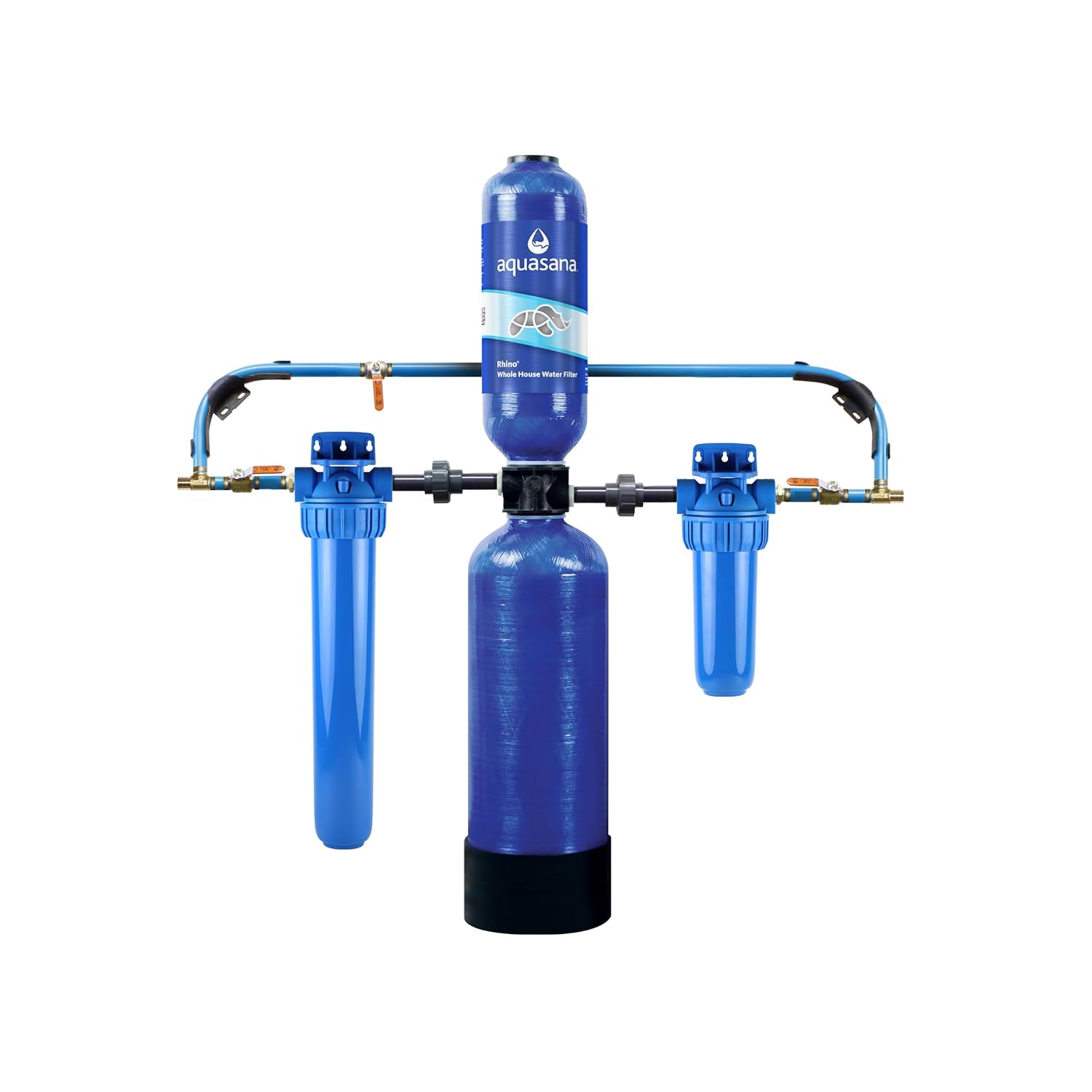
- NSF 42 + 53 certified whole-house system
- 1,000,000 gallons — roughly 10 years of filtration
- 7 GPM flow rate — no pressure drop for the whole home
- Reduces chlorine, lead, mercury and organic compounds
- Salt-free — no wastewater, no electricity, no brine tank
- Low ongoing maintenance vs. under-sink systems
- Does not remove PFAS to reverse-osmosis levels
- Does not soften water or reduce hardness/scale
- High upfront cost (Premium tier)
- Professional installation recommended
- Large tank — needs garage or utility space
What is the Aquasana Rhino EQ-1000
The Rhino EQ-1000 is a whole-house, point-of-entry water filter that treats every tap in the home rather than just the kitchen sink. It uses a combination of catalytic carbon and KDF (kinetic degradation fluxion) process media housed in a large upflow tank, paired with a pre-filter that captures sediment before water reaches the main media bed. Because it treats water at the point it enters the house, it protects plumbing, fixtures, showers, and every faucet — not just drinking water.
Aquasana rates the system for 1,000,000 gallons of throughput, which works out to approximately 10 years for a typical family of four, though actual filter life depends on household water usage and the quality of the incoming municipal or well supply. This is substantially longer than most under-sink systems, which typically need cartridge changes every 6-12 months.
NSF certification — what’s verified
The Rhino EQ-1000 carries two NSF/ANSI certifications. NSF/ANSI 42 covers aesthetic effects — verifying reduction of chlorine taste and odor. NSF/ANSI 53 covers health effects, verifying reduction of contaminants such as lead and cyst-forming organisms (like Giardia and Cryptosporidium). These certifications are independently tested and confirmed against Aquasana’s published performance data sheets, rather than taken on marketing claims alone.
It’s worth noting what these certifications do not cover: the Rhino’s NSF 42 and 53 certifications do not include PFOA/PFOS reduction claims. If PFAS (“forever chemicals”) removal is a priority, look for systems specifically certified under NSF/ANSI 53 or 58 for PFOA/PFOS, or pair a whole-house system like this one with a certified point-of-use reverse osmosis unit.
What it removes — and what it doesn’t
Based on its NSF certifications and catalytic carbon/KDF media, the Rhino EQ-1000 is effective against free chlorine and chloramine taste/odor, lead, and a range of volatile organic compounds and pesticide/herbicide residues commonly found in municipal water. KDF media also helps control bacterial growth within the filter bed itself.
Being transparent about limitations: this is not a reverse osmosis system, so it will not reduce PFAS, nitrates, arsenic, fluoride, or dissolved salts to the degree an RO membrane does. It is also not a water softener — it will not reduce calcium/magnesium hardness or prevent scale buildup in pipes and appliances. Homes with hard water typically pair a whole-house carbon filter like this with a separate salt-based or salt-free conditioner.
Flow rate and filter life
The Rhino EQ-1000 is rated for a 7 GPM (gallons per minute) flow rate, which is sized to avoid the pressure drop that smaller point-of-entry filters can cause when multiple fixtures run at once — for example, a shower running while a dishwasher is filling. The 1,000,000-gallon media rating means most households replace the main tank media roughly once per decade, though the sediment pre-filter should be checked and replaced more frequently (every 3-6 months) depending on incoming water quality.
Installation and maintenance
Whole-house systems like the Rhino EQ-1000 are installed at the main water line, typically in a basement, garage, or utility closet, and generally require professional plumbing installation — this is a larger, more involved job than an under-sink filter. Aquasana backs the tank with a long-term warranty (confirm current terms on the manufacturer’s page before purchase). Ongoing maintenance is limited to periodic pre-filter changes and a media replacement around the 10-year mark, making it lower-maintenance over its lifespan than most under-sink or countertop systems.
Who it’s for
The Rhino EQ-1000 makes the most sense for homeowners (renters typically can’t install whole-house systems) who want chlorine and lead reduction at every tap in the house, are comfortable with a higher upfront investment in exchange for a decade of low-maintenance operation, and either don’t need PFAS-level filtration or plan to pair it with a point-of-use RO system for drinking water specifically. It’s less suited to renters, apartment dwellers, or anyone whose primary concern is PFAS or fluoride reduction — for those needs, a certified under-sink RO system is the better fit.
Rhino EQ-1000 vs SpringWell CF1 vs iSpring WGB32BM
| Feature | Aquasana Rhino EQ-1000 | SpringWell CF1 | iSpring WGB32BM |
|---|---|---|---|
| Price tier | Premium | Premium | Mid |
| Filter type | Catalytic carbon + KDF | Carbon + KDF | 3-stage sediment + carbon block + carbon |
| Rated capacity | 1,000,000 gal / ~10 yrs | ~1,000,000 gal (model dependent) | 100,000 gal (~3 stages replaced separately) |
| Water softening | ✗ No (add-on available) | ✗ No (softener add-on available) | ✗ No |
| Salt-free | ✓ Yes | ✓ Yes | ✓ Yes |
| Best for | Balanced NSF 42/53 whole-house protection | Customizable flow-rate sizing by household size | Budget-conscious whole-house entry point |
Choose SpringWell CF1 if: you want a system sized precisely to your household’s fixture count and want the option to add a salt-based or salt-free softener from the same product line. See our full SpringWell CF1 review for details.
Choose iSpring WGB32BM if: budget is the priority and you’re comfortable managing three separate big-blue filter stages rather than a single long-life tank. See our full iSpring WGB32BM review for details.
Choose the Rhino EQ-1000 if: you want dual NSF 42 + 53 certification, a decade-long single-tank media life, and a 7 GPM flow rate with minimal ongoing maintenance.
Alternatives worth considering
Frequently asked questions
Affiliate disclosure: CleanWaterAdviser participates in the Amazon Associates Program and affiliate programs with Aquasana (Rakuten Advertising), Waterdrop (Rakuten Advertising), SpringWell, and others. We earn a small commission when you purchase through our links, at no additional cost to you. Commissions do not influence our ratings or recommendations.